
Sing whatever is Well-Made: WB Yeats and William Morris
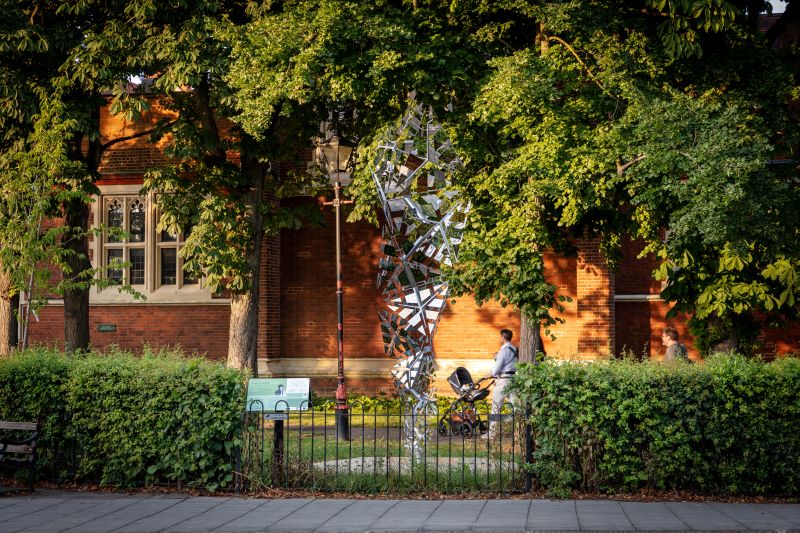
Lecture by Cahal Dallat for the William Morris Society, first published in William Morris Society Magazine: Autumn’23
Enwrought Light
What part does quintessentially English craftsman William Morris play in the life and art of a schoolboy from a London-Irish migrant family who becomes the only poet raised in England to win a Nobel Prize for Literature? Or indeed in that boy’s elevation, as grand old man, to the Senate of a newly independent Ireland for which his literary genius has laid the cultural foundations? Or, more directly, in his writing the world’s best-loved poem of exile celebrating “The Lake Isle of Innisfree” as a kind of “ earthly paradise” set in the rugged West of Ireland landscape of County Sligo, a terrain quite radically different from either of the Morris’s Thames-side Kelmscotts, House or Manor?
And what could either Morris or Yeats have to do with Conrad Shawcross RA’s dazzling Enwrought Light at the entrance to that unique manifestation of Arts & Crafts principles in the real world, the Bohemian/Utopian first-garden-suburb, the would-be “earthly paradise”, that is Bedford Park?
Art reflecting life
On the latter question, Shawcross’s spiral of “golden and silver light” (in addition to, as Rowan Williams emphasised at the unveiling last September, reflecting so many aspects of our everyday lives back to us as does Yeats’s art) actually gives visual form to Yeats’s genius spinning up just yards from the very London “pavement gray” he walked daily, and which he mentions in that much-loved poem of longing. But it also celebrates the dazzling centrifugal effect of Bedford Park’s aesthetic, artistic, progressive, multi-cultural and egalitarian ideas and ideals which were to become central to twentieth-century society, and many of which arose from Morris’s thinking, writing and activism.
As for Morris’s influence on his writing, while Yeats’s gift is to turn Ireland into poetry, and while he acknowledges predecessors from Blind Raftery and Eileen Dubh O’Connell to Morris’s Irish friend, William Allingham, when asked, in his late sixties, what six books he would pick as a kind of “Desert Island” selection, Yeats chooses his own anthology of English poetry (!), plus Homer, Shakespeare, Balzac, and “all of William Morris”. He invariably quotes his literary lineage as Chaucer, Shakespeare, Blake and Morris and his hero-worship is such that he maintains, if he were to be given the chance to live another man’s life, it would be William Morris’s.
While Shawcross’s Enwrought Light comprises both the spiralling gyre and Yeats poem-lines on its plinth, a fuller picture of Yeats’s Bedford Park influences is there for visitors who click on the QR-code on the nearby information sign, to be guided by 2022 Oscar- and BAFTA-nominated Irish actor, Ciarán Hinds on a smartphone tour of Bedford Park, complete with readings of ten Yeats poems, images, and short talks on the people and places who influenced Yeats at each “station” on the walk.
Though to hear the full story the visitor has to leave Bedford Park after the first eight locations and stroll Thames-ward to discover first Chiswick Eyot, the river-island that so reminds the twenty-something Yeats of an island in Sligo’s Lough Gill that he has explored on childhood holidays. And then to find nearby Morris’s London home and hive of arts, industry and, occasionally, anarchism, at Kelmscott House, an essential element in the Yeats story.
A devil of a lot of trouble
It was Yeats’s reading of “The Lake Isle of Innisfree” which sparked my own awareness of William Morris many years ago: at primary school our teacher played a recording of Yeats reading “Innisfree”: or rather, not reading, but chanting, in a manner he attributed to Morris. In his introduction, on that 1932 BBC recording, he tells of meeting Morris storming out of a lecture-hall where, he says, a young man has just read a passage from Morris’s poem “Sigurd the Volsung” as if it were prose. “It gave me a devil of a lot of trouble”, Morris says, “to get that thing into verse”. And so Yeats, who values craftsmanship in poetry and frequently admits he goes to a lot of trouble to get his own poems into verse, shows that he sees Morris’s chanting as central to the English poetic tradition.
One of Yeats’s famous couplets is “Irish poets learn your trade / sing whatever is well made” and one can imagine that idea of “a trade”, and things being “well-made”, coming directly from Morris’s belief in workmanship, in things well-wrought, in traditional craft. So Yeats wants his work seen as “applied art in literature” rather as Morris’s was “applied art in design”.
A poet in admiration of “beautiful lofty things” (as Morris insisted one should have nothing that wasn’t useful or beautiful) Yeats describes Morris’s Kelmscott Press Chaucer as the most beautiful book in the world. Yeats’s copy is a fortieth-birthday present from Augusta Gregory, his partner in founding the world-famous Abbey Theatre. And intriguingly, among the friends Lady Gregory invites to help pay for Yeats’s gift, is her sometime lover Wilfrid Scawen Blunt, who is also a former lover of Morris’s wife, Janey, whose other long-term extra-marital relationship was with Morris’s friend Dante Gabriel Rossetti.
The book, as well as simply being beautiful, is a reminder for Yeats of his Kelmscott House days: a quarter of a century later, around the time Yeats recalls the Morris anecdote for his BBC recording, he goes back to visit May Morris at Kelmscott Manor in Oxfordshire and talk of those shared times.
Morris, Pre-Raphaelites and Bedford Park
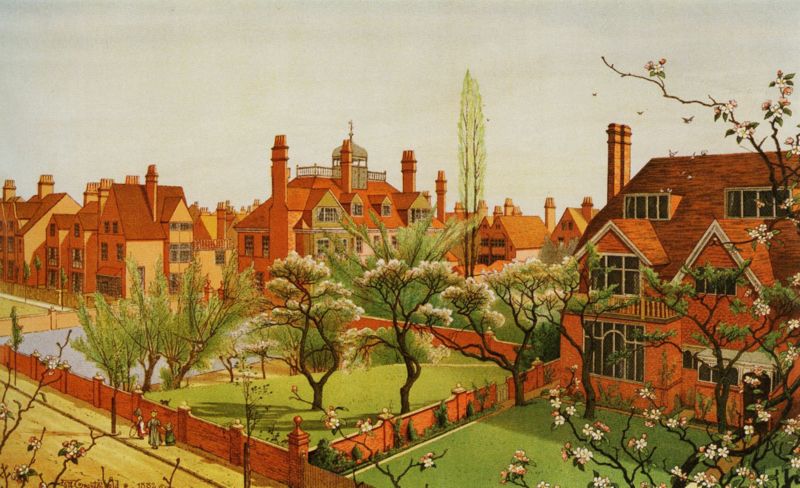
Lady Gregory’s gift is also a reminder of growing up in Bedford Park, Chiswick, where Morris’s influence is all around.
Chiswick appeals to Morris (who moves here in 1872 before taking Kelmscott House) as the nearest unspoilt village location within easy reach of his central London shop. And when Dublin-born Jonathan Carr hears in 1875 that the railway is coming to Chiswick he can imagine other artists being similarly attracted by the area’s rural village ambience and sees the potential for a new kind of housing development which he sets out to create, enhancing the development’s artistic credentials by copying the red-brick-and-tiles look of “The Red House” in Bexleyheath that Morris designed and had once envisaged as the beginning of an artists’ commune.
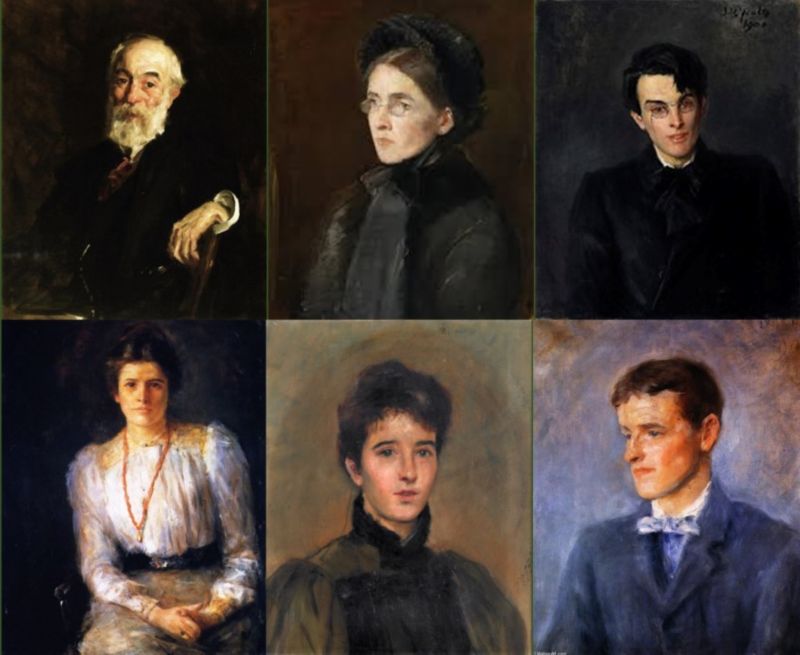
Jonathan Carr has artists in mind for his new suburb, recognising their desire to live in beautiful surroundings is always in conflict with the need to pop cheaply into town, to galleries and theatre, and to sitters and patrons, typically actors, politicians and aristocrats. And perhaps he also imagines artists will enjoy meeting socially and expounding endlessly on art and the meaning of life because his own family are arty and Irish and love great talk, as does portrait painter John Butler Yeats (referred to hereinafter as JBY, distinguishing him from son, William Butler Yeats, simply referred to as Yeats). JBY is one of the first painters to take up residence here, an Irish lawyer abandoning his vocation for the artist’s life.
The chances of attracting artist tenants are rather enhanced by the fact that Carr’s brother is J. Comyns Carr, poet, art-critic, playwright, and director of the Grosvenor Gallery, exhibiting Pre-Raphaelite painters (and Morris’s best friends) Dante Gabriel Rossetti and “Ned” Burne-Jones. So early Bedford Park residents include Pre-Raphaelite artists Edward Blair Leighton and T Matthews Rooke, Burne-Jones’s studio assistant, who paints the inn-sign for the new Tabard pub and lives here until 1942. Both choose Queen Anne’s Gardens, a quaintly winding road which appealed to many artists, recreating the sense of a winding village road somewhere deep in England’s pastoral past.
Rooke’s house is the epitome of the new aesthetic. The Yeats children are taught country dancing there by Rooke’s sisters and the interior décor adds to Yeats’s thrill, as a young boy, at the mediaeval, fairy-tale aspect of Bedford Park:
My two sisters and my brother and myself had dancing lessons in a low, red-brick and tiled house that drove away dreams, long cherished, of some day living in a house made exactly like a ship’s cabin. The dining-room table, where Sinbad the sailor might have sat, was painted peacock-blue, and the woodwork was all peacock-blue and upstairs there was a window niche so big and high up, there was a flight of steps to go up and down by and a table in the niche. The two sisters of the master of the house, a well-known pre-Raphaelite painter, were our teachers, and they and their old mother were dressed in peacock-blue and in dresses so simply cut that they seemed a part of every story.
Another Pre-Raphaelite, John Trivett Nettleship, shares JBY’s studio: his wife Ada Nettleship is best known for the glimmering beetle-wing-sewn dress she and J. Comyns Carr’s wife Alice create for Ellen Terry, lover of Bedford Park’s first architect E.W. Godwin and mother of Yeats’s stage designer and sometime Bedford Park resident, Edward Gordon Craig.
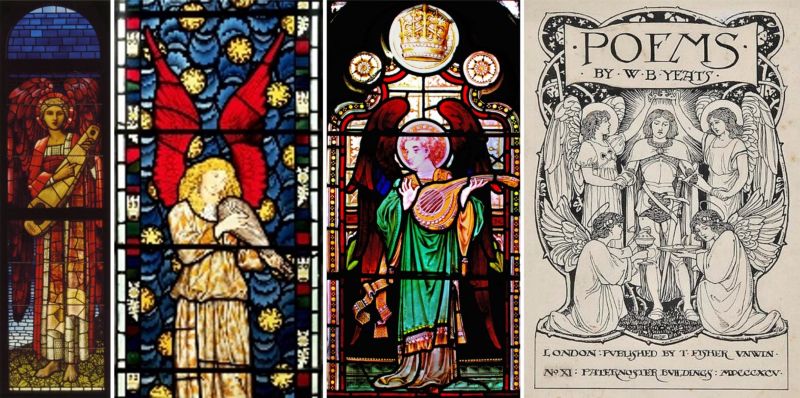
St Michael and All Angels Church is central to the growing community. And in Yeats’s poem “The Travail of Passion”, which opens with the “lute-thronged angelic door thrown wide” we see evidence of time spent there at Sunday service. The first two images on the smartphone trail for this location show Burne-Jones’s and Morris’s angels with lutes elsewhere, the third is actually in the church here and the final image is the frontispiece from Yeats’s 1890s poetry collection, so angels abound in Bedford Park.
As do Morris’s textile designs: exiled Virginian clergyman, Moncure Conway, a leading early-Bedford-Park figure, suggests in the community’s own newspaper that William Morris will almost certainly need to set up shop here soon, so great is the demand for Morris products.
Communal Happiness
For the first time in London, houses are not only being built in red brick rather than grey London Stock but, in Bedford Park, are being built without the dank basements and garrets that characterise the city’s steep Victorian terraces And the far-sighted development, aimed at communal happiness rather than profit, includes church, inn, stores, social club with a small theatre, a tennis courts and, inevitably, a school of art.
Radical, in terms of house design and work-life balance, the suburb was anti-imperialist, feminist (the club, uniquely, admitted both men and women), progressive and egalitarian as was Morris. When Morris dies the Times hails him as England’s greatest poet, saying very little about design or the Arts-&-Crafts movement and nothing about his Socialism. Yet Yeats, writing years later to Maud Gonne, his life-long unrequited love-interest and the revolutionary he met in Bedford Park, suggests that in his William Morris days, rather than Irish Nationalist, he was “vaguely communist”, a word that would send shock-waves through twentieth-century conversations but a word that Morris would use comfortably and that would have sat easily with Bedford Park intellectuals. “Vaguely communist” like Morris who had wealth but believed in ending the evil of class distinction, and vaguely “communard” like “ communal” Bedford Park.
Meeting a master
Born in Dublin and brought up in London from age two, Yeats is thirteen when his father decides to move his family from Kensington to the new and artistically congenial suburb. But the Yeatses’ inherited rental incomes are running out due to Gladstone’s land reforms, and JBY isn’t earning enough to keep his family even in a relatively economical artists’ colony. So after a couple of congenial Bedford Park years the family retreat to Ireland and JBY tries his hand as a Dublin portrait painter. Meanwhile Yeats finishes school and becomes interested in Celtic Culture as philologists are uncovering the richness of Irish legends much as English philologists are exploring the Scandinavian sagas that are the wellsprings of Morris’s writing.
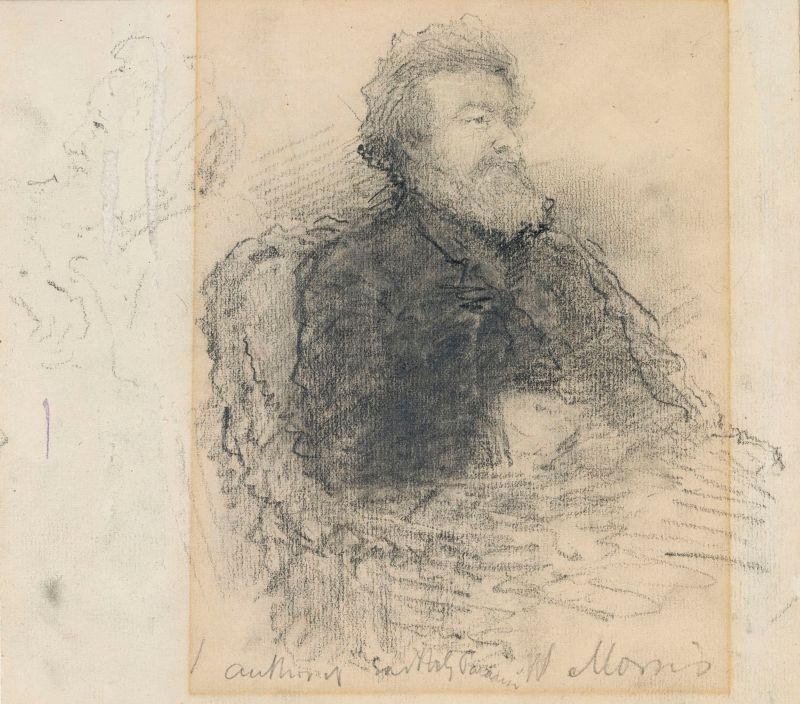
At Dublin’s Contemporary Club, in April 1886, JBY sketches Morris – who’s come to talk in support of Irish Nationalism – and twenty-year-old Yeats introduces himself to the guest speaker as an admirer, in a career-defining moment.
Kelmscott Sundays
The following April the family move back to London, portrait painting having proved no more profitable in Dublin, and by May Yeats is attending Morris’s Sunday evenings. Here he meets Ernest Rhys who, a few months later, commissions him to edit a collection of Folk and Fairy Tales of the Irish Peasantry. And on 19th June he attends a lecture at Kelmscott by May Morris’s fiancé H H Sparling, on Irish Rebel Songs, a decidedly un-English topic, but in line with Morris’s anti-imperialism and campaigning for Irish independence. (Sparling later edits a book entitled Irish Minstrelsy and includes a Yeats poem.)
At a Kelmscott supper the following Sunday Morris asks Yeats to write for his political journal, “Commonweal”. After which Kelmscott House becomes Yeats’s regular Sunday-night artistic and intellectual stimulus with gatherings that include R B Cunningham-Grahame, Eleanor Marx Aveling, and Annie Besant, an Irish socialist campaigner who becomes a Theosophist, as Yeats does, then moves to India, to become first woman president of the independence movement, the Indian National Congress.
Peter Kropotkin would be there, from Moscow, as well as Ukrainian, Sergius Stepniak, both noblemen who have left Russia where anarchist politics have proved troublesome. Stepniak has fatally stabbed the Moscow chief of police and now edits Free Russia from Bedford Park (he lives right behind the Yeatses): he also features in The Railway Children by another Morris associate, Edith Nesbit and is the hero of a co-authored novel, A Girl Among the Anarchists by William Rossetti’s daughters, that’s Pre-Raphaelite William, brother of DG Rossetti and married to Lucy Madox Brown daughter of Pre-Raphaelite painter Ford Madox Brown who is a founding partner of William Morris’s design company.
Later, when Shaw writes “Arms and the Man” he seeks Stepniak’s advice on Bulgarian Army uniforms as the local expert on East European armed forces!
Yeats meets Shaw at Morris’s in February 1888, his diary entry reading: “…last night I met Bernard Shaw who is certainly very witty…his mind is somewhat wanting in depth…” And then Yeats meets Florence Farr there: she is Shaw’s leading lady and sister to Henrietta Paget, an old art-school friend of JBY’s, and next-door neighbour to JBY’s old Trinity College Dublin friend, Irish poet and playwright John Todhunter.
By April Yeats has started taking French lessons in the Coach House. He doesn’t, however, excel in French and when in Paris he decides to visit the symbolist poet, Stephane Mallarmé, Mallarmé is out and Yeats’s garbled French explanation to Mme Mallarmé never reaches the poet’s ears. As it happens Mallarmé was in Bedford Park with Icelandic scholar York Powell at the time!
In April ‘88 Yeats meets Morris’s typographer friend Emery Walker whose home and printing industry are just a few doors along Upper Mall. In June he attends Morris’s play at the Socialist League Hall. In November May Morris and fiancé Sparling are the Yeatses’ supper guests. Later in the month Willie visits a Kelmscott House Arts-&-Crafts exhibition with his sisters. And a week later Lily Yeats starts work as an embroiderer for May Morris, for whom Florence Farr is already working.
Soon Yeats sees that Morris can be useful to him not just in terms of the Kelmscott social circle but as an influencer. He goes to the Friday French class with sister Lolly on 18th January ’89. Next day he sends a copy of his new book The Wanderings of Oisin to May Morris in the hope that she’ll show it to her father, believing Morris will approve of this legendary tale. And on Wednesday he meets William Morris bustling along High Holborn, who tells him: “That is my kind of poetry!”
Soon Yeats, captivated by Morris’s chanting and its connection with tradition and the Romantic era, asks Morris to write him a verse play to perform in the Bedford Park Social Clubs’ little theatre. Morris declines as he doesn’t believe contemporary actors know how to chant verse so Yeats approaches Todhunter who writes a play and asks his neighbour’s sister. Florence Farr, to act in it. Which leads to Yeats and Farr creating a new art-form, chanting to the psaltery, a mediaeval instrument frequently played by angels in Burne-Jones and Morris’s stained-glass works, and re-invented by Arnold Dolmetsch.
And just as the Ernest Rhys connection at Kelmscott leads to Yeats’s first publication, so discovering Florence Farr’s delivery leads to his desire not simply to write a play, as Todhunter has done, but to write an Irish play for an Irish literary theatre which will tell Ireland’s story, not as Shakespeare told England’s, through kings and queens and dynasties, but through the lives of ordinary people.
At the Pagets’s Christmas party, Farr announces that she has funding from a friend, Annie Horniman, to stage a season of plays which will include Shaw and Todhunter, and asks Willie if he’ll write a play, based on his folk and fairy-tale research, that will include a role for the Paget’s daughter Dorothy, Florence’s niece, as a fairy.
Yeats writes the play, setting it in his maternal home-place in Sligo. And Horniman later provides the funding for Yeats to create the Abbey Theatre with Frank and Willie Fay, and Lady Gregory, former lover of Janey Morris’s former lover Wilfrid Scawen Blunt.
The Abbey Theatre concept sets the scene for contemporary “people’s theatre”, after a nineteenth century of drawing-room comedy and tragedy. Without Morris’s Sunday nights and Bedford Park’s club theatre, no Oklahoma!, no Look Back in Anger, no Theatre Workshop.
And equally important perhaps, no Cathleen Ni Houlihan, the play that Yeats speculated might have sent the leaders of the Easter Rising to their deaths. No modern independent Ireland. And probably, though it’s a longer story, no Indian independence. A perfect example of how the Bedford Park/Kelmscott House connection worked in the wider world.
Learning your trade
For some Shawcross’s Enwrought Light artwork, a thing “such as Grecian goldsmiths make / of hammered gold and gold enamelling”, as Yeats would put it, is both Yeatsian gyre and a vision of Bedford Park’s influence spinning out over the world. Or a flock of Yeats’s white birds, a flourish of leaves “in their autumn glory”, a flock of angels from nearby Saint Michael and All Angels…
But key to the work is its title, with the word “enwrought” from the Old English word for “worked” which we still have in “wrought iron” and “overwrought”, though the trades to which “wright” (a very Morris word) applies are all traditional occupations, “shipwright”, “wheelwright”, “cartwright” and “wainwright” (with the exception of “playwright”, a trade Morris and Yeats shared).
And it’s worth thinking about the opening line of the poem that inspired Shawcross, which is “Had I the heaven’s embroidered cloths”, and wondering what would make a young poet regret that he was unable to give a lover the finest gift he could imagine, embroidered cloths. Of course he’s talking about the heavens, about the glittering night sky he painted on his bedroom ceiling, with brother Jack, in their Blenheim Road home, but he’s also surrounded in Bedford Park houses, with the rich cloths his sister Lily and Florence Farr embroider for May Morris.
Lily’s sister Lolly (they were actually Susan and Elizabeth but the family’s pet-names stuck) also works for May teaching children’s art classes. And Lily enjoys being at Kelmscott House because of the stream of visitors and the high talk of Morris, Shaw, Cunningham Grahame and others. But likes it less when the business expands and the embroidery department moves to nearby Hammersmith Terrace, which isn’t the social centre that Kelmscott House has been.
The changed conditions eventually lead to a falling-out with May Morris, and to Lily’s father composing an indignant letter to May Morris about how his daughter had been treated. JBY won’t be the only father to write a verbose and bombastic note to someone he feels has mistreated his daughter.
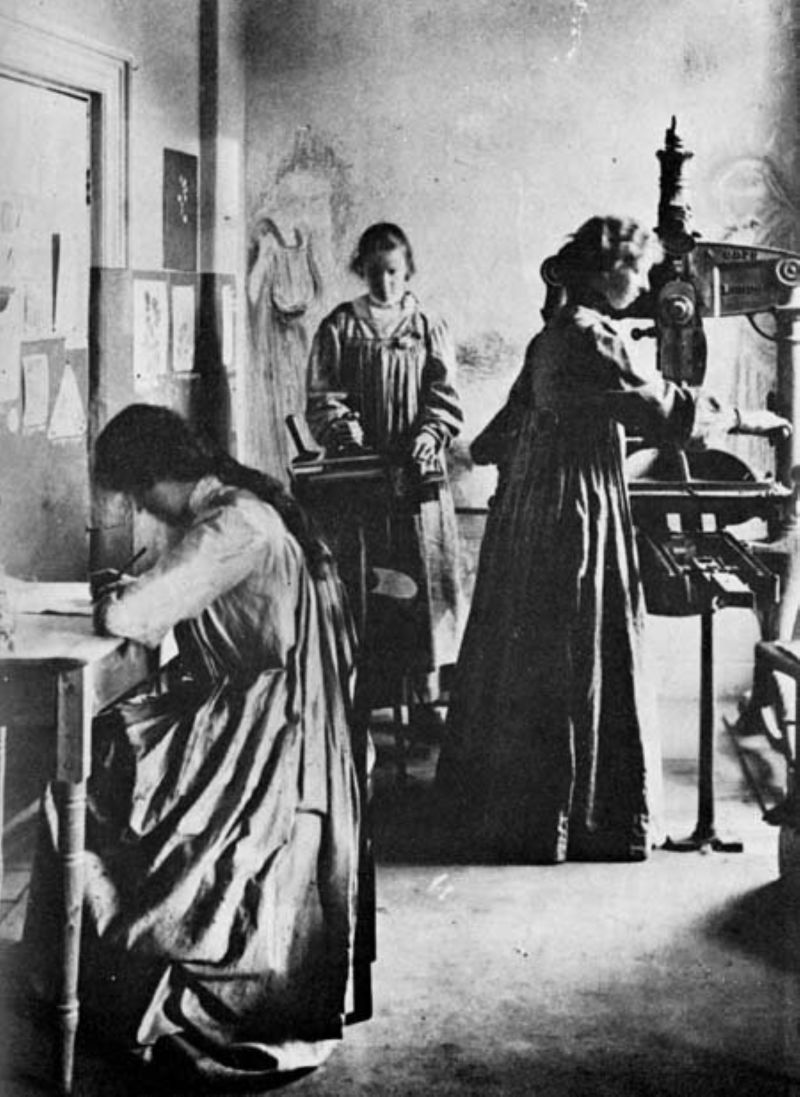
May Morris counters with the accusation that Lily’s work hasn’t, in fact, been satisfactory. This may simply have been anger as, after their mother Susan dies, Lily and Lolly move to Dublin with JBY and found a small press and a craft industry based on both the practical experience of Morris’s “industries” and the inspiration of the English Arts-&-Crafts movement. From their “Dun Emer” craft studio they issue hand-printed limited editions with one of their first publications being Yeats’s selection of poems by Morris’s friend and lifelong correspondent, William Allingham. Others include broadsides of poems with illustrations by brother Jack who had attended Chiswick School of Art in Bedford Park and goes on to become Ireland’s greatest (and highest priced) twentieth-century painter.
So Kelmscott House is influential in creating the Irish craft industry which still thrives today and which revives, as Morris does for England, a whole range of traditional skills. And in creating an Irish fine-press tradition. And a people’s theatre which not only influences drama internationally but, along with Yeats’s poems, played a major part in the cultural revival that was the soft diplomacy behind Ireland’s struggle for sovereignty.
“The wrights that wrought…”
And on the poetry front we can see how “embroidered cloths” “enwrought with golden and silver light” such as the tapestries the poet’s sisters were producing as part of Morris’s craft revival, help inspire one of Yeats’s great love poems.
But the poem we associate most closely with this period is that much-loved poem of longing, “The Lake Isle of Innisfree”.
In his novel, John Sherman, Yeats writes of a young, lovelorn Irishman in London, strolling Chiswick Mall and Upper Mall a few hundred yards from his home, and tells how the osier-covered island there, Chiswick Eyot, reminds the young man of an island in Lough Gill in Sligo. The story reflects not only Yeats’s longing for escape to a pastoral life but Morris’s love of the rural, and his longing for “revolution” in the literal sense of turning back the wheel of history to a simpler time, to self-sufficiency, one’s own beans, and honey, and to only having useful things, or beautiful things. Escape to, as Morris’s first novel title had it, The Earthly Paradise.
But my interest in Morris started with Yeats’s story about Morris’s rhythm. And one of the striking aspects of “Innisfree” is not simply that it was prompted by a river-island close to Kelmscott House but that Yeats went to “a devil of a lot of trouble” to get his Utopian dream into a verse form that’s very similar to the one Morris used – that he maintained was being misused – in Sigurd the Volsung.
The first three lines in each of the Yeats poem’s three stanzas are each actually two half lines:
I will arise and go now, and go to Innisfree
And a small cabin build there, of clay and wattles made
Nine bean-rows will I have there, a hive for the honey-bee…
Just as Morris opens with
There was a dwelling of kings // ere the world was waxen old
Dukes were the door-wards there // and the roofs were thatched with gold
Earls were the wrights that wrought it // and silver nailed its doors…
We might notice, in passing, Morris’s “wright” and “wrought” as well as “gold” and “silver” which found their way into Yeats’s “Cloths of Heaven” poem around this time (and Shawcross’s artwork) but take note of where “there” falls in the middle of the second line of both poems – the word is repeated four times in Yeats’s poem, three in that mid-line location. And look at the alliteration, already an unfashionable aspect of the last Romantics, but Morris has “world” and “waxen”, “dukes” and “door-wards”, “wrights that wrought” (followed by “weaving-women”, “mightiest men” and “bickering blast”) while Yeats’s poem, despite its plain contemporary language, has “bean-rows” and “bee-loud”, “have”, “hive” and “honey-bee”, and later “glimmer” and “glow” and “lake water lapping with low sounds”
So for Yeats, Morris isn’t just the focus of intellectual thought and artistic ideas, the hub of a creative network, the poet who can put him in touch with opportunities and connections: he’s a master of verse form, and an old verse form that we find in “Sigurd”, the Morris poem Yeats remembers in his sixties.
Glimmer and Glow
There’s one particular line of Yeats’s most-famous poem which has always puzzled readers: “There midnight’s all a glimmer, and noon’s a purple glow”. Yeats talked vaguely about purple light on the water at noon. But the truth outs when we look at the poem’s first draft, the one he wrote when he walked from Chiswick Mall and Kelmscott House back up to Bedford Park and went straight upstairs with his mind burning with images of Chiswick Eyot and Innisfree…
He first wrote “There noontide be all a glimmer, and midnight a purple glow”. Much more realistic. But the line wasn’t beautiful and Morris says “have nothing about you that you don’t believe to be beautiful”. And so when Yeats changes the words to “Midnight’s all a glimmer // and noon a purple glow” he matches Morris’s line, goes to a lot of trouble to match that ancient Anglo-Saxon rhythm, and thereby creates something that sounds beautiful.
What he also creates is almost surreal: the glimmer at midnight, of course is also heaven’s embroidered cloth again, the firmament he’d painted on his bedroom ceiling, or Ada Nettleship’s glimmering dress. But that purple glow at noon takes us worlds away, into a science-fiction fantasy world such as that to which Morris’s legends and sagas would take us, a genuine “earthly paradise” when compared with the London roadways and grey pavements that both knew so well.
And so we see why Yeats’s most precious possession is the Kelmscott Chaucer, why he learns poetry from Morris as a tradition handed down, a trade to be learned, rather than merely something expressionistic and self-indulgent, and why he cites Morris, journeyman poet, craftsman and thinker, as his “master” throughout his life.
Images (above)
(1) Enwrought Light by Conrad Shawcross, photo by Richard Ivey. Unveiled Sep 2022 a few yards from the Yeatses first Bedford Park home (1879-1881)
(2) The Tower House, Bedford Park by Bedford Park resident, Adolf Manfred Trautschold
(3) Angels – with lutes by EdwardBurne-Jones & Wm. Morris, and (3rd, to the right, high above St Michael& All Angels’ altar) by Daniel Powell (1840-1904, photo by DavidBeresford); & St Michael with four angels in Yeats’s 1895 Poems frontispiece
(4) WilliamMorris by John Butler Yeats, sketched at Dublin’s Contemporary Club, April 1886
(5) TheYeats family: clockwise: John Butler Yeats (JBY) and Susan Pollexfen Yeats, WilliamButler Yeats, Jack B. Yeats, Elizabeth (“Lolly”) Yeats and Susan Mary (“Lily”)Yeats
(6) The Yeats sisters at Dun Emer Press, Dundrum, 1903